A Good Life

A visual tool to help people with disability have more choice and control over their daily activities.

The problem

Often when we talk about the support of people with a disability, the conversation turns to cost and risk. To complex systems that are difficult to change. To overwhelming amounts of information and high staff turnover.

This collaborative project between Northcott Innovation, Parallel Lines and the UTS School of Design reorients this narrative. We took a person-centred approach to help Northcott ask:

“Are we supporting you to have a good life?”

The process

To better understand the complexities of disability support, we used design-led methods and more traditional and ethnographic methods.

We diagrammed, mapped and prototyped. We listened and talked to people with disability and support workers. We observed and we read. At the centre of all this, was the person being supported.

We learned about rostering, training, funding and assessments and how these things affect people with disability, their choices and their quality of life.

What we found

We noted three key things that contribute to the complexity of disability support.

Multiple levels of decision-making

There are multiple levels of decision-making that surround the person being supported. People make decisions every day that affect this person, from the frontline worker providing support, to the those furthest away, like a Government minister. Amongst the sometimes competing priorities of these people, the person receiving support can become lost, moved from the centre of the decision-making process to the periphery.

A digram that illustrates the multiple levels of decision-making around a person with disability receiving support

Costs and gaps in funding

Many people with disability are individually funded by the National Disability Insurance Scheme (NDIS). However, tensions between how the scheme is structured, assessed and implemented persist, particularly for those living in group homes, or supported living. To demonstrate this, we developed a series of visualisations that highlight the difficulties Northcott customers face on a day-to-day basis.

A humorous diagram that shows how things can be partially funded, like half a dinner half and half a pair of glasses.


Risk v choice

There are many tensions to negotiate for people receiving support, and those providing it. Many of these centre on the ongoing tussle between risk and choice. Risk is not easily regulated or understood, and it often comes up against the notion of choice. When the NDIS was put in place it was said to provide choice for people with disability. In reality, providing choice day-to-day is not that straightforward. Underpinning this are different interpretations of ‘quality of life’. Whilst being injured is undesirable, avoiding risk entirely limits choice and the potential of a full life. We created decision-making triangles as a way for staff to discuss this complexity. It revealed that many people have differing interpretations of risk and quality of life.

What me made

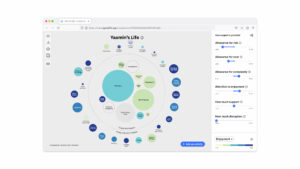
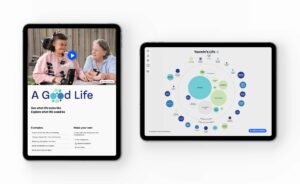
A Good Life is an interactive web-based tool for creating and sharing visualisations of a person’s life. It provides a rich and clear understanding of a person’s lived experience and allows users to better understand the balance between cost, complexity, risk and quality of life in support and care contexts.

It could be seen as visualisation of a personal profile, of what someone is doing, and what they would like to do.

What it enables

Deeper understanding of the customer

A Good Life efficiently communicates information about how a person being supported spends their time, and importantly, their preferences. Many individuals with complex disabilities may struggle to communicate with support staff, making it difficult for staff, especially those unfamiliar with them, to understand their preferences for enjoying their day. A Good Life provides a clear insight into what brings joy to customers’ daily lives and helps staff prioritise their support accordingly.

Enables staff to identify and plan for positive change (and avoid blame) with the person being supported.

The tool enables staff to identify and focus on actions that will make a positive difference to the customer. It enables staff to see through the ‘noise’, to focus on ‘just one thing’. AGL becomes a shared reference point from which to plan. Staff are given insight into what they can change, the small actions they can make which can have immediate impact. These are distinguished from the larger systemic issues, which are outside of their control.

Provides a way to measure positive change over time

This tool can be used to measure tangible and less tangible positive changes over time. By reviewing the visualisations at different intervals (for example, month by month, year by year) it will become possible to see important changes that are not captured by existing methods.

Impact

We won an award!

A Good Life won an Australian Good Design Award in 2024 in the Social Impact category.

Thank you to the Profield Foundation

We thank the Profield Foundation who have generously supported this project as part of their commitment to addressing social disadvantage and improving the well-being of all Australians.

Want to know more? Want to get involved?

We are continuing to develop A Good Life as a platform. We’re testing it with people with disability and support workers. Like to know more? Contact us.